


Is It Still Worth Investing In SEO Content Wr...
Read More
You are doing it all: publishing blogs, posting on social media, maybe even running email campaigns and yet the traffic is not coming. Right? The leads are not converting. The rankings are stuck on page two or three, collecting digital dust.
Here is the uncomfortable truth: 91% of content published online gets zero traffic from Google, according to an Ahrefs study analyzing over one billion pages. Zero. Not a trickle, nothing.
That is not a content problem. That is a content marketing strategy problem.
A strategy tells you why you are creating something, for whom, and how it connects to an actual business outcome. Without it, you are just adding to the noise. And in 2025, with AI-generated content flooding every niche at an industrial scale, the noise has never been louder.
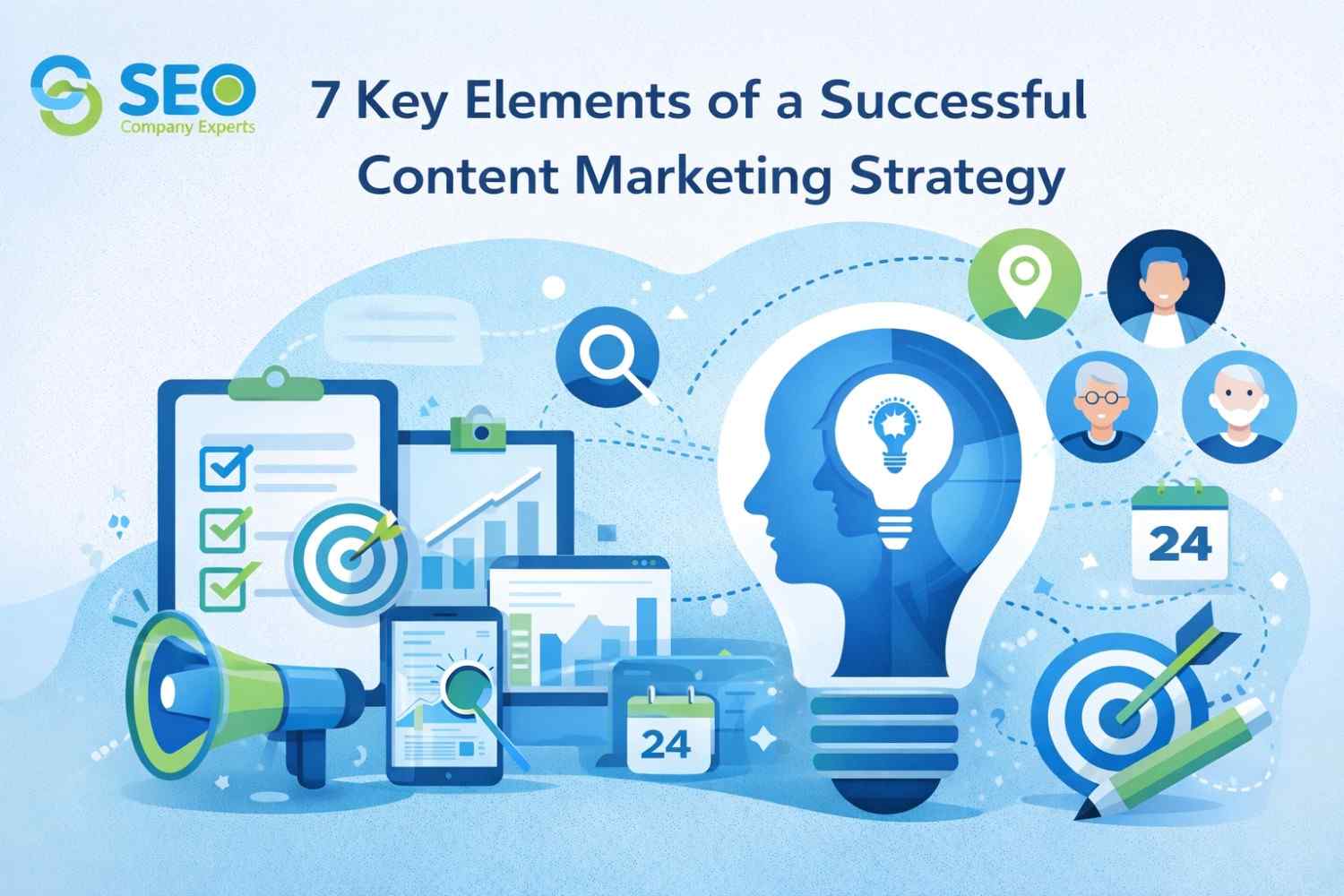
This guide is not going to tell you to “post consistently” and “know your audience.” You have read that a hundred times. Instead, we are going to break down the 7 elements that actually separate content that ranks and converts from content that disappears.
Every successful content marketing strategy begins with understanding your audience. But here is where most businesses go wrong they stop at demographics. Age, profession, location. That is table stakes. That is not insight.
Real audience understanding means getting into the psychology of the person sitting behind that screen. What are they afraid of? What have they already tried that didn’t work? What does a “win” look like for them this quarter?
HubSpot’s 2024 State of Marketing report found that marketers who document their audience personas are 2x more likely to report higher ROI from their content efforts. The documentation itself forces clarity.
So yes know who they are. But more importantly, understand:
One useful exercise: pull your last 20 support tickets, sales call recordings, or customer reviews. The exact phrases people use when they are frustrated or excited? That is your content goldmine. That is the language your blog should mirror.
It is also important to revisit your audience understanding every 6 months. Market conditions shift, new competitors enter, and user behavior on search engines evolves constantly.
Once you understand your audience, the next step is building a structured plan but not the kind that just lists “publish 3 blogs a week.” That is a production schedule, not a content marketing strategy.
A truly strategic content plan is built around topic clusters. This is how Google’s algorithm rewards expertise today. Instead of writing isolated blogs on random topics, you build a pillar page with one comprehensive resource on a broad topic and surround it with cluster content that goes deep on specific subtopics. All of it links back to the pillar. This signals to Google that your site has authority on a subject, not just scattered opinions.
For example, if your pillar page is “Content Marketing Strategy,” your cluster content might cover: content audits, editorial calendar templates, content repurposing workflows, SEO content briefs, and distribution frameworks. Each cluster page feeds authority back to the pillar.
Your content plan should include:
The Content Marketing Institute’s 2024 B2B report found that 64% of the most successful content marketers have a documented strategy. Only 19% of the least successful ones do. The document is not the magic the thinking that goes into creating it is.
Quality is one of the most critical elements of a successful content marketing strategy but “quality” is a word that gets thrown around so loosely it has almost lost meaning. Let’s define it properly.
In Google’s own documentation on the Helpful Content System (updated 2024), quality content is content that demonstrates first-hand experience, provides original information or analysis, and offers something beyond what you could find on the first page of results. They call this E-E-A-T: Experience, Expertise, Authoritativeness, and Trustworthiness.
What that means in practice:
Consistency matters enormously here too. Backlink’s analysis of 912 million blog posts found that consistent publishing cadence directly correlates with domain authority growth. Posting regularly builds trust with both your audience and search engines.
The goal is not to be the loudest voice in the room. It’s to be the most useful one.
This is where most content marketing strategies silently fail, and it is worth spending more time here than most guides do.
Search intent is the why behind a search query. Google has become extraordinarily good at understanding it, and if your content does not match the intent of the query you are targeting, you will not rank no matter how well-written your piece is.
There are four types of search intent:
Informational – The user wants to learn something. (“What is a content marketing strategy?”) → Your content should educate, not sell.
Navigational – The user is looking for a specific brand or page. (“HubSpot content strategy template”) → Not relevant for most blog content.
Commercial – The user is researching before a decision. (“Best content marketing tools 2025”) → Your content should compare, analyze, and guide.
Transactional – The user is ready to act. (“Hire content marketing agency”) → Your content should convert, with clear CTAs.
Most businesses make one of two mistakes: they write informational content for transactional keywords (ranking for the wrong audience) or they write sales-heavy content for informational queries (ranking poorly because Google sees a mismatch).
Before you write a single word, run your target keyword through Google and read the top 5 results. What format are they? What depth? What questions do they answer? That is Google telling you exactly what it considers the right answer for that intent. Your job is to do it better, not differently for the sake of it.
The user intent signals you match correctly today compound into authority signals that keep working for years.
Here is a principle that changed how a lot of serious content teams operate: spend 20% of your time creating content and 80% distributing it.
Most businesses flip this. They pour everything into the writing and then share it once on LinkedIn, maybe send it in a newsletter, and move on. That piece then sits on the website getting visited by occasional search traffic or more often, nothing at all.
A strong content marketing strategy treats distribution as a system, not a task.
Think about how one piece of long-form content can move across channels: a 2,500-word blog post becomes a LinkedIn carousel that gets 10x the reach of a plain link. The key insight from that post becomes a short video for Instagram Reels or YouTube Shorts. The data points become tweet/X threads. Three related posts get bundled into a lead magnet PDF for email capture. The same content then gets pitched to industry newsletters and media publications as a guest post.
That is one piece of content doing the work of seven.
Distribution channels worth building deliberately:
The brands that dominate content marketing in 2025 are not the ones publishing the most. They are the ones distributing the most intelligently.
One of the biggest advantages of a digital content marketing strategy is that almost everything is measurable. Yet data is the element most businesses either ignore entirely or use incorrectly pulling numbers that make them feel good rather than numbers that tell them the truth.
There is a big difference between vanity metrics and growth metrics. Page views feel good. Conversion rate tells you something real.
Metrics that actually matter:
Tools like Google Search Console (free, underused, incredibly powerful), Google Analytics 4, Ahrefs, or SEMrush give you this data. The goal is not to collect it but to build a monthly review rhythm where you ask: What worked, what did not, and what does that change about next month’s plan?
That review loop is what turns a content marketing strategy from a document into a living system.
Not everyone who lands on your content is ready to buy. In fact, most of them are not and if you treat them like they are, you will lose them before they ever become a customer.
A successful content marketing strategy maps content to where people actually are in their decision-making process.
Awareness Stage – They have a problem but are not sure what the solution looks like yet. Create content that educates, names the pain they are experiencing, and builds trust. Think: “Why is my website traffic dropping?” rather than “Hire an SEO agency.”
Consideration Stage – They understand their options and are comparing. Create content that helps them evaluate comparisons, case studies, how-tos, and deep dives. This is where you demonstrate expertise without overselling.
Decision Stage – They are close to acting. Create content that removes final objections testimonials, detailed service pages, ROI calculators, free trials, demos.
Now here is what takes this from strategy to brand: across all three stages, the emotional thread running through your content should tell a consistent story. Not a sales narrative a human one.
What does your business actually stand for? What do you believe about your industry that others are afraid to say? Who are the real people behind the brand, and why do they care?
Your brand story should live in your content through how you write, the examples you choose, the data you highlight, and the positions you take. Customers do not remember every blog you published. They remember the feeling your content gave them whether it made them feel understood, smarter, or more confident.
Consistency in tone, messaging, and storytelling across all content is what turns a reader into a subscriber, a subscriber into a lead, and a lead into a long-term customer.
This section does not exist in most content marketing guides which is exactly why you should read it carefully.
AI tools have made content creation faster and cheaper than ever. The result? A flood of generic, templated, technically-correct-but-completely-forgettable content across every niche. Google’s Helpful Content System updates have been a direct response to this algorithmically identifying and deprioritizing content that exists to rank rather than to genuinely help.
What this means for your content marketing strategy:
The brands that will win content in the next three years are not the ones who use AI the most. They are the ones who use AI for scale while investing in human expertise for depth.
Even businesses with the best intentions make these and they are worth calling out clearly:
Creating content without mapping it to intent. Great writing on the wrong keyword intent does not rank. Period.
Ignoring keyword research entirely. Some businesses swing the other way “we just write what we know.” That is content for your ego, not your audience.
Treating distribution as optional. Publishing without a distribution plan is like opening a restaurant in the middle of a forest. Excellent food, no customers.
Not updating old content. Google actively rewards freshness signals. A blog from 2021 with outdated statistics and broken links is actively dragging your domain down. An audit and refresh of your top 20 pieces can deliver results faster than writing 20 new ones.
Measuring the wrong things. If your monthly report celebrates page views while your leads are flat, you are optimizing for the wrong outcome.
A content marketing strategy is not a document you write once and file away. It is a system one that improves every month because you are feeding real data back into real decisions.
The businesses that win are not publishing the most content. They are publishing the most useful content, to the most relevant audience, through the most strategic distribution channels and they are measuring what matters, not what looks good in a slide deck.
In 2025 and beyond, with AI saturating every niche and Google’s algorithms getting sharper at identifying genuine helpfulness, the only content marketing strategy that works is one built around real expertise, real experience, and real value.
Start there. Build consistently. Measure honestly. Improve continuously.
That is how content marketing stops being a cost center and starts becoming your most powerful growth engine.