PPC Management Services: The Complete Guide t...
Read More
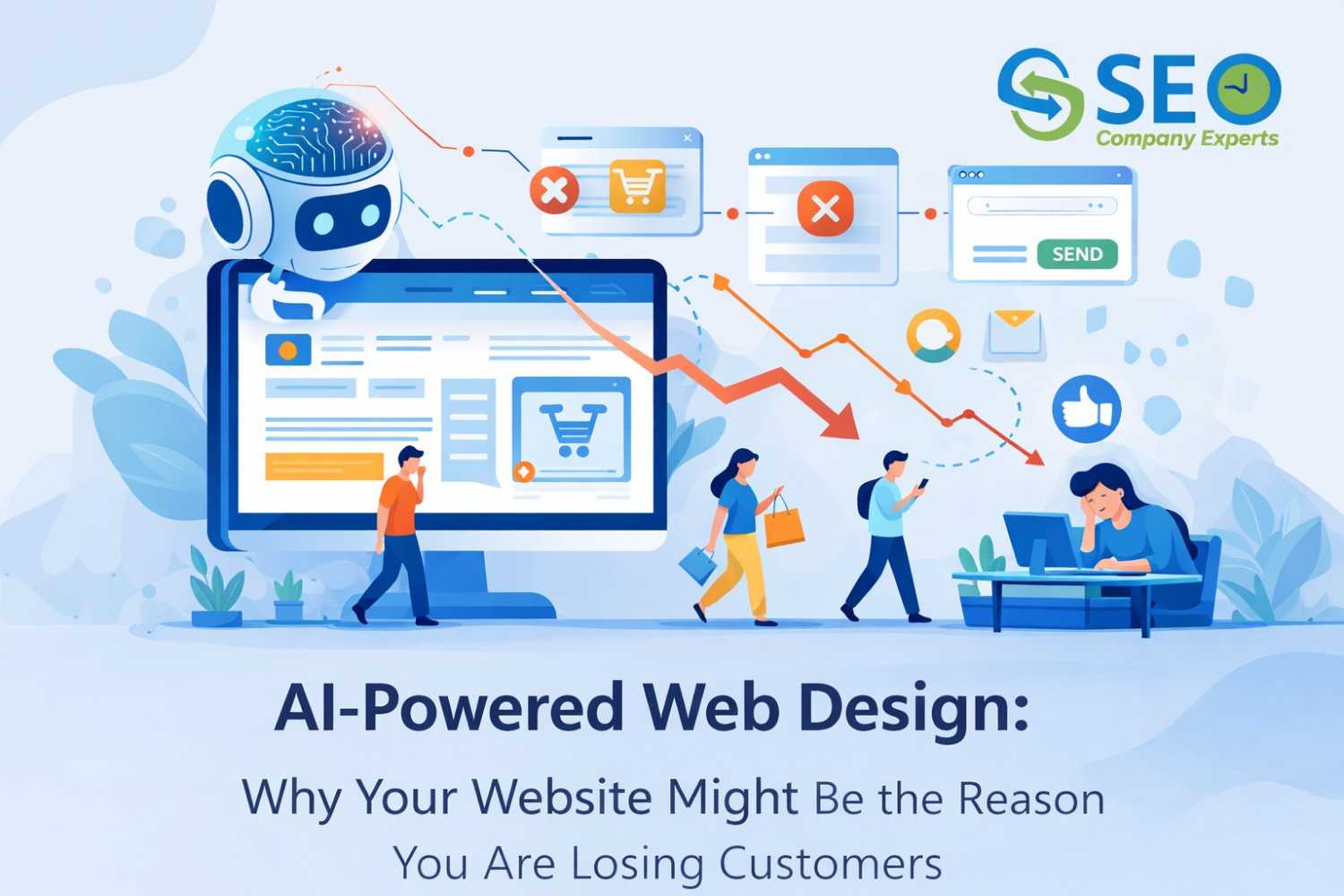
If your website looks great but still loses visitors, you are not alone. A lot of businesses spend good money getting a site built, it looks clean, loads okay, and covers all the basics. But the traffic comes in, and nothing happens. People leave. The form does not get filled out. The product does not get bought.
Well, we have seen that so many times, the actual problem is not the design, but it’s actually the static website. When your website is the same for every visitor, including the first-time visitor who has no idea what you do or someone who has been on your pricing page three times this week, that gap between what a user needs in that moment and what your website actually shows them is exactly where you are losing people.
That is the problem AI-powered web design is made to fix. So, through this blog, we are going to walk you through what actually is AI-powered web design. Not only this, but we will also be discussing everything that you should and are required to know about it. Even if you have never heard about website design artificial intelligence, after reading this complete guide, your basics will be cleared.
AI-powered web design uses artificial intelligence to build, manage, and improve websites in a way that responds to real user behavior in a far better way.
This uses some really useful tools like machine learning, natural language processing, and predictive analytics. In practice, what that means is your website can show different content to different visitors.
Not just this, but it also fixes its own performance problems and guides the users toward action without you having to manually update everything every time something stops working.
It is a big shift from how websites have traditionally been built, and honestly, a lot of businesses are still catching up.
Data is the only foundation for that, because AI tools stack what your users are doing on your website.
Which pages do they visit?
Areas where they click
How long do they stay?
Sections where the users drop off
The device they are on.
All that data gets thoroughly analyzed, and the system starts making smarter decisions based on it. This way, you will not need to check if the home page CTA button should be bigger, or the home page intro should be shorter or not.
Well, in more advanced setups, it makes changes like these automatically without waiting for a developer to step in. This is where a reliable web development service becomes critical, ensuring the AI infrastructure is set up correctly from day one.
Before you decide whether this is something worth investing in, it helps to know what you are actually getting. These are the features that show up in real results.
Tools like Uizard and Figma AI Assist can take your brand inputs and generate multiple design options in minutes. This does not replace a designer, but rather it removes the blank-page problem completely and speeds up the early stages of a project by a lot. This works best when paired with a professional graphic design service that brings your brand identity into the AI workflow from the start.”
This is probably the biggest one. AI can show different content to different users based on what they have done before. Someone who has visited your services page twice might see a call to action that a first-time visitor would not. Someone coming in from a specific location might see content that is relevant to them.
That level of relevance is something static websites simply cannot do.
A chatbot powered by natural language processing can understand what a user is asking and actually respond to it in a helpful way, not with a canned script but with a response that matches the question. This matters a lot because most users will not wait around trying to find information on their own.
AI does not just look at what users have done. It also predicts what they are likely to do next. If a pattern shows that users who visit page A almost always want page B, the system can surface page B without the user having to search for it. That kind of friction removal adds up fast.
Slow websites lose visitors. That is just a fact. AI tools handle things like image compression, code cleanup, and load balancing automatically. You do not have to manually monitor these things and catch problems after they have already cost you traffic.
Also Read: Rise of AI-Powered SEO: What Marketers Need to Know
There are a lot of tools that call themselves AI-powered without really delivering much. So what actually separates the effective setups from the ones that just add noise?
The biggest difference between AI web design and traditional web design is where decisions come from. Traditional design relies heavily on what looks good or what someone thinks users want. AI design relies on what users are actually doing. That is a meaningful difference in outcomes.
A website built with AI in the loop does not stay the same. It keeps learning as more users interact with it. That means six months from now, your site should be performing better than it is today without you rebuilding it from scratch.
What makes AI web design effective is that every design decision is connected to something measurable. Lower bounce rate. Higher conversion. More time on the page. The design is not just about aesthetics. It is about whether it is actually doing the job.
User experience is how someone feels when they use your website. If they feel confused, they leave. If they feel like the site understands what they need, they stay, and they come back. AI improves this in ways that are pretty direct.
This is one of the most underrated AI web design user experience benefits. A repeat visitor who has already looked at your pricing should not see the same homepage banner as someone who has never heard of you. AI makes it possible to serve each person what is actually relevant to them at that moment.
AI can identify where users are getting confused or stuck and flag those points for improvement. Over time, this creates a much smoother path from landing on the site to completing whatever action you want them to take.
Speed is directly tied to user experience, and most businesses underestimate how much a slow site is costing them. A one-second delay in page load time can drop conversions by a significant margin. AI handles the performance side automatically, so it is one less thing to manage.
AI chatbots mean someone is always available to help a visitor find what they need, regardless of the time. And honestly, a lot of users prefer finding an answer quickly over waiting for a response the next morning.
Apart from the user experience side, here is what AI-powered web design actually means for the business.
A lot of the tasks that used to require hours from a developer or designer can now be automated. Layout options, content suggestions, A/B testing, performance fixes. Those time savings add up and reduce overall costs.
One of the clearest benefits of AI web design is how much it compresses the timeline. AI-generated layouts, automated testing, and smart content tools mean you can go from idea to live website significantly faster than with traditional development.
When your website adapts to each visitor and removes friction from the experience, more of them take action. You do not necessarily need more traffic to see better results. You just need the traffic you already have to be met with a more relevant experience.
Low-code and no-code AI platforms make it possible for non-technical team members to manage and update the website. That matters when your business is growing, and you need the website to grow with it without adding headcount to make it happen.
The clearest way to answer what the benefits of AI web design are is to compare what each approach actually gives you.
Traditional web design gives you a solid, well-built website that reflects your brand. But it is static. It does not adapt. It requires manual updates. And it treats every visitor the same way, whether they are a first-time browser or someone who is one step away from buying.
AI-powered web design gives you a website that keeps learning and adapting. It responds to real behavior, improves over time, and connects every design decision to actual business outcomes. The tradeoff is that it requires the right tools and the right setup. Done badly, you get a lot of features that do not actually help. Done well, the difference in performance is hard to ignore.
AI web design is not a fix-everything solution, and it is worth being straightforward about that.
It depends on the data. In the early stages, before enough users have interacted with your site, the AI does not have a lot to work with. The improvements get more meaningful as traffic builds.
It still needs human judgment. Your brand voice, your creative direction, your understanding of your customers, none of that comes from an algorithm. The best results come from combining smart tools with people who actually understand the business.
And the tools change fast. What works well right now may be replaced by something better in six months. Staying on top of that is part of the commitment.
Well, we hope that now you may have a clear idea of what exactly an AI-powered website is and how it works. In case you are looking for an experienced and genuine team that can help you in creating a responsive AI-powered website, we are always here to do that for you.
One thing is for sure: after choosing us, you will never have to search for AI-powered website services near me. So, just do not give it another thought and just click here to schedule a direct discussion with our trusted team or to get a free quote.